
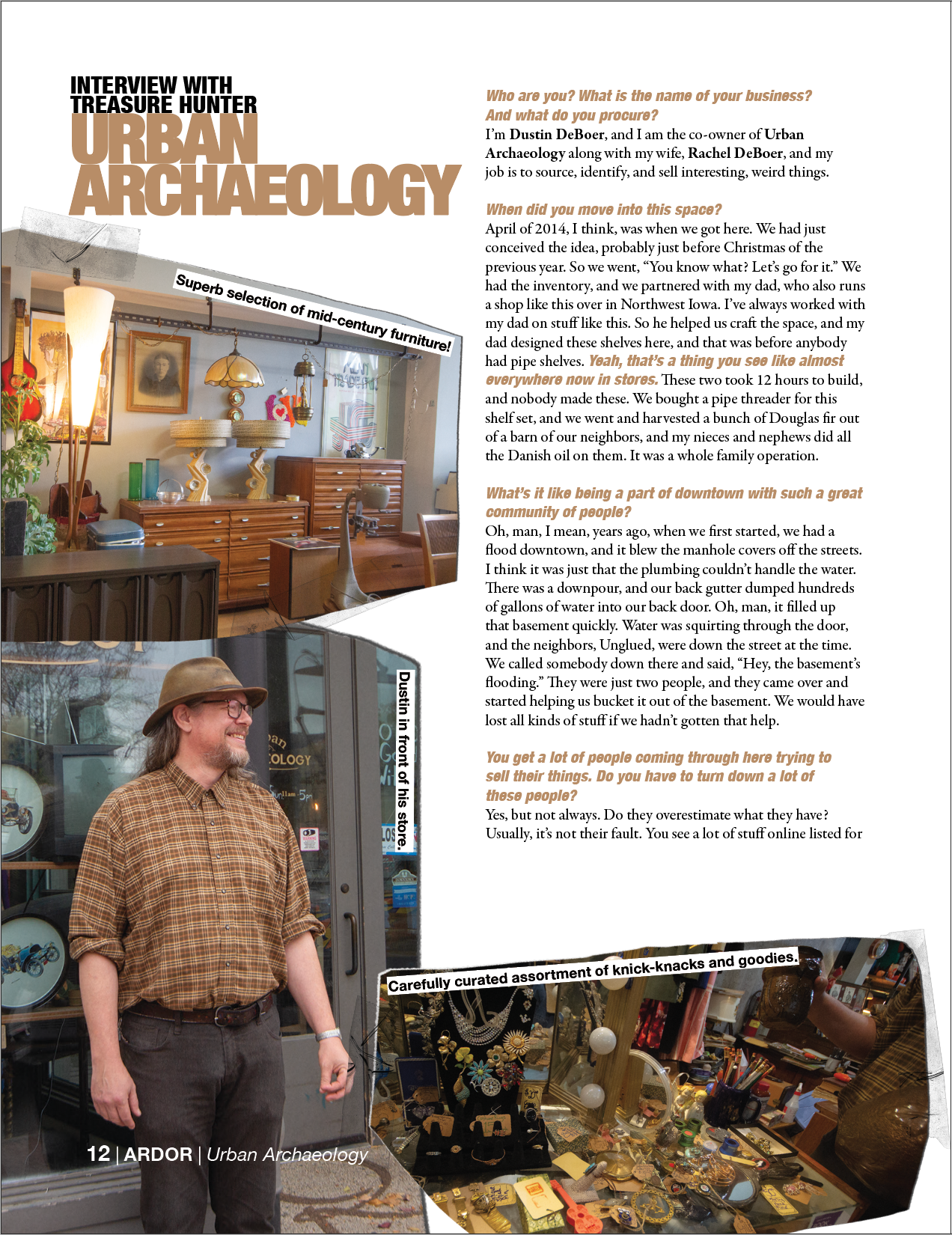
One of my recent projects has been to create a magazine from scratch. This has been my favorite assignment thus far, as we had to create all of the content and design the magazine in its entirety. Part of my magazine consists of interviewing a local business; I decided to interview Urban Archaeology. They are a vintage goods and antiques store located in downtown Sioux Falls, SD. We were only given one spread to work with, but our conversation lasted 1.5 hours!!! Dustin, one of the owners, is such an interesting person that I couldn’t live with myself to leave out so much. So I decided to upload the entire interview here! Below is my final design with a very heavily abridged conversation, and below that will be the interview in its entirety. Enjoy!!!

I had lots of fun designing this, but it was a struggle to work with so much text for only 1 spread.
- First basic questions here: Who are you? What is the name of your business? And what do you procure?
- I’m Dustin DeBoer, and I am the co-owner of Urban Archaeology along with my wife, Rachel DeBoer, and my job is to source, identify, and sell interesting, weird things.
- What role does Rachel play in the business? Does she do more of the back-end stuff?
- We’ve been here for quite a while and for many years she did my job. So she ran the front end of everything and it was her main job to make things run smoothly here. And then we started schooling our kids from home and then COVID and then things kind of got shifted toward me spending the majority of my time putting into this into this business. Chances are if you get the opportunity to speak to me through the internet its actually Rachel. Yeah, she’s the one doing all the social media stuff.
- You guys dont have much of a social media presence right? Is there no team just you and your wife?
- Is it just she and I, and a community of cool people that just we’ve kind of made networks. I think we got lucky or we had either set ourselves up right or got lucky combination of the two. To have the ability to do that social media presence in a way that not a lot of business owners could do it at that time when we were on social media. Now there’s like all the resources you needed right there. Already having had success doing that with social media through the band, Sidehouses, and we already had, you know, a decent following for a tiny little thing at that time, we knew how to turn that into public interest. We could kind of knew how to, you know, and a lot of our fans with that kind of followed us over to the business right away.
- And we we’ve mentioned the band already twice. So for the uninitiated what is this band?
- It’s just the thing that Rachel and I did before this, that made this possible, because we were we would play shows at the place next door before Pave was Skelly’s, and that was an Irish pub and we would get hired to go and play over there now and then. And that just kind of made us see the potential in Sioux Falls and like the way that people would participate in like the zombie walks and things like that, and we were just like, wow, people like get involved around here. We just weren’t used to that, you know? And so that made it just, okay, well, we needed something to do with all of our stuff. And that just kind of led to, you know, um, the band led to us considering this town for this space and, you know, for doing, even doing a business in this area. The band was just something that I really wanted to do for a long time. I met Rachel with doing playing in like a little punk band in Sioux City, and I she knew I always played music. I was just rogue music and kind of just played music in the basement and then one day we had a little extra scratch and I said,ey, you want to play drums? And she said, cool. And we just kind of made that into another thing and then turned that into we live in soothouses and that we did for a while and then we realized we can’t do a business and a kid and a band; something had to give.
- And I think that’s keeping it a small team has really made it possible to be passionate, right?
- Yeah, people who told me to do that, though. They’re like, oh, man, you need to get bigger. You need to move into another space. And even when we got this place, I was told this place wasn’t big enough to do what I do. I was like, well, if I do, then, you know, I would always use the little shop before, you know, as an a great analogy. It’s like, dude, think about it. The place is calling you saying, hey, feed me, you know, I need this. You need more stuff. You need more, you know, you got to do more. And it’s already becomes that. You know, it becomes all consuming. So why make it bigger from the start than what you know? Yeah. Yeah, this really is kind of like a perfect size store, honestly. I think it’s just right. It doesn’t give you more than you need. It’s got, you know, the tall ceilings, so it makes a confined space seem big, you know, because it really isn’t that wide, you know, are not really big shops, but shotgun shop or whatever.
- So, you what kind of what is the time frame of all of the starting? When did you move into this space when?
- April of 2014, I think, was when we got here. It was summertime around then. Yeah. And then, we just conceived the idea probably just before Christmas of the previous year. And so we just went, you know what? Pretty, yeah, we go for it. We, you know, and we’re like, all right, well, we’ve got the things and we partnered with my dad, who also runs a shop like this over in Northwest Iowa. And so, you know, and I’ve always worked with my dad on stuff like this. And so he helped us kind of craft the space and my dad designed these shelves here, and that was before anybody had pipe shelves. Yeah, that’s kind of like a thing you see like almost everywhere now in stores. These two rustic 12 hours to build and nobody made these. We bought all of this from the store. We bought a pipe threadder for this shelf set. And yeah, he was making like stuff with a framework on the backside, so you kind of hide the pipe, you know, a little bit. And we were like, nah, let’s just put the pipe on the front. Just bring it right out to the front, you know? And we went and harvested a bunch of Douglas fur out of a barn of our neighbors and made the shelves out of that and my niece and nephews, did all the Danish oil on them and scrub them up and yeah. So it was like a whole family operation. That’s so cool when you’re able to like bring in friends and family to work on projects with that with you. It makes it just like so much more special. We’ve always had people. I don’t accept help very well, but there’s always good people that like when the chips are down.
- But that’s like that’s another part of being downtown such like a great community, like downtown Sioux Falls, right?
- Oh, man, I mean, there’s years ago when we first started, we had a flood downtown and it like blew the potole, the manhole covers off of the streets and it was like, I think it was just that the plumbing downtown couldn’t handle it or whatever. But it started, there was a downpour, and our back gutter dumped like hundreds of gallons of water into our back door. And that was when we had a basement door. Oh, man. And so it filled up that basement area. And water was squirting through the door around the door. And the neighbors, unglued, was down the street at the time. And we just called somebody down there and we were like, hey, the basement’s flooding, you know, and they heard and they were just like, two people came over and started helping us buck it out of the basement, you know, getting water out of here. And like, we would have lost all kinds of stuff if we hadn’t gotten that help.
- I’ve come in here and talked to you a lot of your past and your stories that you like to tell. And I always love listening, but before you did all of this, I know you hopped around between a lot of different professions. Do you think that experiences and doing different stuff like that really helped you kind of build this thing from the ground up?
- Well, this is built on experience just because everything is, it adds to the whole, you know, every bit of knowledge adds to the collective knowledge that you have, you know, and so just the more stuff, you know about, the more you know about the people who made that stuff. Yeah, and then the picture fills in over time, the more you know and the more people you talk to, the more conversations you have, it’s all imperative. I mean, to have a full worldview, and I don’t have a full world. You know, I’m not like the most worldly person. But I’ve talked to people who really are. And, I think that counts for something. I think that, you having done a lot of different jobs with people who have, you know, run from through the jungle, from the Chinese government, or, you know, like things you definitely don’t want to have to experience, but they’re willing to share their story with you and, you know, just to understand them a little better, you know, is all and to understand life and the potentials of life and like, man, I got it good. I used to, years ago, I took a job. It was like some staffing company. And there were famous on the front range out by Boulder and I got these jobs every day at just a new job. They would call me up and tell me to go to a different place and and they would give me the day jobs because I’d take anything. You know, I’d just show up, not even knowing what I was going to do and they’d like put a shovel in my hand or they’d hand me a box of dove bar, soap, you know, boxes that I was supposed to sort through. Or goodness knows, man. I mean, I did everything. And so for like three months, I did a different job every day. Yeah, it was experiences just kind of build up, right? The culmination, like you’re saying. Well, and that, so what that really puts you is, so like, your understanding of of the people who make this stuff, the people who, and the children are the people who made this stuff and bought this stuff and what they appreciated about it and, you know, I mean, for me, that’s what I see when I see this stuff is like I see the whole picture of those weird little things and all the people that I met finding that stuff. So’s probably like more of a selfish passion, really.
- I know you get a lot of people through here coming here, maybe trying to sell certain things or trying to off-load. You have to turn down a lot of these people, right?
- Yeah, oh my god, I mean, not always. Because maybe they’re kind of overestimating what they have? Usually, it’s just not their fault. It’s the most money they can get, you know, and that makes sense. And then it’s misinformation a lot of times it’s just not like it just a lack of understanding of how this stuff works, you know, or what makes something worth something, you know, just because it’s the same age or just because it’s rare, you know, it takes a lot more than that to. Yeah. There needs to be a market, a demand for it. There’s a Venn diagram for everything, and it all needs to fit in that or else it’s just any other thing. A lot of people just don’t have that kind of frame of mind. They don’t have that kind of information just in their head. Well, I look at it and I can tell you all about it without even having to pick it up. And that is the culmination of a life’s work, of just trying to know stuff. If I didn’t know what it was back in the day, I would just buy it and then research it. And sometimes it was like totally worthless. Okay, I spent that money on that thing, but I bought an education.. I know more now, you know? And every time I mess up on a deal, it’s a learning lesson, and it’s not just the world is out to get you.
- I would say my specialty more in like clothing realm, right? When I first started collecting stuff I would look at the tag. Who made it? Where were they, you know, where was their factories? Right. And a lot of people don’t realize it’s the time that you’re putting into the product, right? And that’s why people walking in here, maybe see a lot of these prices, they’re like, oh, wow. But why is this like this? Why is it so high? You know, you’re pricing your time into it also.
- I think of it as a sieve, like the things you choose and the things you don’t, because there’s the world is a river of stuff. And if you take a sieve to that, what passes through the sieve? And what makes it worth keeping, you know? And that’s not always high value, but it tends to be when you do those other things that cross over. It’s like, it took somebody a lifetime to learn how to do that. I knew what to appreciate about those things that made it worth being in here. And that’s what caught it in the sieve, is that it’s it’s cool enough. It was expensive then. It’s probably kind of expensive now that is a tendency to be, you know, and why it was expensive was because people had to put their effort into it. They bought they paid a designer. They sourced the best materials. They their neighborors knew they worked there. Yeah. And if they bought something crappy from them, they’d go, hey, this is a piece of crap and you need to give me my money back. So it kept things, there was a pride of manufacturing, and therefore, a pride of ownership, because when you spent the money, like now you spend the money on something that’s designer, and it’s probably not worth what you spent on it. There are probably some things out there that are just like, okay, they may be popular right now, but they’ve been going on for hundreds of years. Japanese metal making or, you know, pottery or like things that take like just generations of knowledge to do. And just because it’s popular now doesn’t mean that it hasn’t had, you know, intrinsic and, you know, real true value in the past too. But that’s what leads to a high price is the time for just getting the stuff is tough, you know, finding something that’s in beautiful condition and worthy of bringing back, you know, bringing, you, taking the time and space just to have it on the floor here is this special. I’m not surprised that people get sticker shock when they look at the best of a thing. You know, you don’t walk walk into a, like a Ferrari or a Lamborghini store and go Go why is it so high? Not that all this stuff is of that quality either, you know, I think it’s like I’m choosing some of this stuff with whimsy. I’m choosing it with tongue in cheek, like the idea that, hey, remember this? You know, or maybe this should be remembered, you. Even though you all want to throw them away, I’m holding on to this idea that this should be remembered. And, you know, it’s my argument with a future anthropologist. I think that’s another thing that has gained throughout the years of doing stuff like this or just being in the world as you gain your taste, right? You gain a taste of, okay, this looks awesome, and I know why this looks awesome. Once you’ve seen the good stuff, everything else looks like crap. That’s just how it is. Yeah. Once you know a real real gold feels like, everything else is just gold plated and you know it, you know, and you can feel it and it just tell you can tell the difference. And that crosses, you know, a good watch. You know, I mean, sure, they’re making Rolex knockoffs now that just feel like a real Rolex, right? But in the past, it used to be that if you held a heavy watch, you knew that was a quality watch because they couldn’t make a cheap watch heavy necessarily, you know. Even though I have seen old watches with like little lead junks in them and stuff to get them some heft, you know? Crazy. But there again, they understood that to make it seem like it was quality, they could get a higher price for it. They would add money for that little chunk of lead because people would be like, yeah, well, it feels like I’m wearing a quality watch. There’s characteristics of these things that you got to look out for. Just certain things. And just like these tulip tables here, like these tulip based pieces here, they are ripped off to the nth degree now. You know what I mean, and have been for decades because when people see that spread out tulip base, they just instantly go, oh, well, that’s cool. That’s that’s a Jetson stuff. Exactly. And instantly it conjures an image of sleek interiors and stuff, you know? So, it’s funny how those are qualities that we know, you having been aware of good design for long enough, like we know what good design is, the average person doesn’t know, but they feel it.
- Running a shop isn’t the easiest; The work/life balance isn’t there, right? And I know that you tell me stories of you going out to these farms in Iowa, these families that you have relationships with and you buy out their stuff. Is that something that you still kind of deal with is having just that work and after work kind of mindset?
- Well, I don’t get an after work, really. I’ll try to pack it all into a certain period of time, and then when I do get a day, it’s just another thing. It’s another existence entirely. So that way, I don’t get messages. I don’t have to stop my son from saying something to me. And that’s the whole point of doing this is all for them. You know, I mean, really, everything I do is to make money, to support my family, and ultimately, I’d probably be off, you know, bouncing around the country, buying cool stuff out of people’s barns if that wasn’t what I was doing. I think that’s like, that’s a big differentiating people of like, who actually really passionate about their things and who’s kind of just doing it, just causes are you doing it outside of work still, even like, when you want to relax? It’s all consuming. And everything I’ve done in the past leads, it feeds into what I do here too. I used to screen print and run a little screen printing business and learned on like some of the, you know, some famous presses, you know, from back in the day that now, you know, taught me lessons just by knowing how things are made and understanding how a print is made, I can look at a T shirt and tell you what they did wrong or what error was made because T shirts start to look different at a certain point. You know, the designs all started looking like, well, they’re making this an Adobe and they know it, right? Because this is this is stuff that only you can do in there. Yeah. And that changed that changed design and it became really flat. Everything became really flat for a period until we started to go back to the old way of thinking like of printing with more, you know, layers and you know, four color process at least or something. Limitations were the signifiers. This is this because they didn’t have the technology yet to be able to do anything else. That teaches you so much. So then when you’re going to bid a pile of shirts or something, you know, these aren’t shirts prior to 1990 or whatever. They just can’t be, you know, because they they couldn’t do this. But the more interesting ones are always the hand cut designs. You know, the stuff from, you know, Squeegee’s car wash down the street, you know, it’s got this, you know, somebody in that shop made this squeegee, you know, and had to hand cut it and do this weird stuff. And the fade to it and you’re like, oop, they didn’t cure the red well. You know, the red’s almost gone and everything else is strong, you know? And it’s always, you know, that stuff, it just, it teaches you so much. And I don’t know. I get way too excited about that stuff. No, I’m the same way too, Like the stuff that wasn’t really made for anything, like the parking lot bootlegs are always so much more interesting, always so much more cooler than like the actual official stuff that would come out at that time. The fan made stuff sold out of the van or the bands who didn’t have a record label that made their own shirts, like literally in the van on tour, you know and that stuff is just, like, we all did that. Like, I remember, I had friends. I would print their T-shirts for them, you know, and they’d be like, hey, would you print a pair of underwear? I’m like, yeah. But, they’re going to punk shows and selling this stuff at punk shows. So just hilarious. The memories that that come along with these items. That was the Sioux City band, by the way; It was the Chicken Hawks. They were The Hawks. That was Pete Phillips and Tammymy Javondi. It must be some chicken Hawk stuff out there, but I printed all their shirts. If you find a shirt, it was made by me. Pete Phillips was like supposed to pay me the first of every month. Tammy would show up to my house and be like, hey, here’s 50 bucks. Pete’s never going to get the money. Yeah. No, but everybody’s cool. Like, we all love each other, but yeah, no, they’re all doing different things now. Do you know Paul Chelsted from Sioux City? I think he did like the Uncle John’s Merals and I think any stenciling or anything like that around town Sellor, he did the the Francis Canteen wall thing. I can’t remember. But he also did the Water tower at the at the Saturday in the park. But we would screen print. He would give me designs to screen print for him and they were usually just like, whoa. You know? Uncle John’s, who I bought a shirt that said, I dig chicks with big, you know, and it they said those were too dirty. And they were like, yeah, we can’t sell these.Paul was mad. For someone who’s into music, I don’t know much about the Sioux City scene, but there’s just so much history there. There is. I only know just a little bit compared to like the friends of mine that were really part of a lot of that, you know? I was part of it, but I was like, I just dip my toe in the Sioux City scene and met my wife, you know, and we were we were still part of things, but we were so attached to each other in 17 and in love,
- What kind of stuff do you wish people knew more about being in this business?
- Well, I think that some of the value is that there’s more depth to the items that I’m choosing. I’m choosing this item. You know, if you look into it a little more, and that’s why I always encourage people to do research before they buy something then you understand why it’s a cool thing and you’re not just taking my word for it. Yeah. So, I guess I’d love people to be more educated on the subjects, you know, and I’ve really struggled with like, how to get that information out to them, even if they’re not asking for it. Yeah. I mean, that’s a tough thing to do. But of course, you know, you ask me about it and I’ll tell you more than you want to know, probably. I think a lot of things would follow. I want to love people.
- What are some couple things that you love getting in the shop or you currently love right now?
- Yeah, it’s a hard question, because it’s every five minutes. It’s a new thing or a new obsession almost, you know. I love things that make things. I like things that print, I like photography, I like printing presses, I like, you know, musical instruments, things that play music, Scientific, gadgets. I love, you know, just history. It’s all related. You know, the guy who ran this plant, his son was in the war and his son met these people overseas, and they sold him this thing, and they gave it back to the family, and now there’s this whole circle that, you know, and God, you just, it’s all interesting. There’s so many viewpoints that you can look at stuff at. And you have to focus sometimes, like with what you’re doing, you know, like the idea of clothing or the idea of fashion or, you know, that idea, you know, it kind of just like puts a finer point. It filters it down so you don’t have to kind of worry so much about everything else. And I used to just do pottery, like pottery was like my main thing. I really thought was cool and I would buy everything else and resell it, but I would really just kind of keep pottery and I knew like the glazes and the makers and that was one of my obsessions was really like, knowing how a piece was made, knowing what the clay base was and the glazes and all that kind of stuff. Would you say you like getting that stuff in then when you see it, whenever you see it? Yeah, absolutely. Yeah. And for me, I want to see something I haven’t seen before. You know, that’s it really. The other stuff’s cool, and I appreciate being able to help people with that knowledge and tell them what things are. And I could make some money knowing what things are, but really, the thing I don’t know is worth more to me than the things I know, and it doesn’t matter what it’s worth. You know what I mean? That’s more to me. Yeah, I love that stuff. I get wicked weird about my passions. I just do. I just I can’t help myself. I think a lot more people need to be like that. Yeah, you wonder if people were, would it make them understand other people more? So they’d see somebody who’s, you know, a new designer and they’d go, gosh, you know, I mean, they’re charging $125 for that shirt, but they designed that shirt. Yeah. You know, and they chose that fabric and they all of this is very specific, you know, stuff. But people don’t even see that. They don’t see the depth of the outline of something almost, you know, it any further than the depth, you know, the outline. Very shallow understanding of whatever’s going on. Well, and that makes things like fast fashion just possible because you’re willing to overlook the quality, you know. It’s got a good outline, good enough, you know.
- There’s kind of trend cycles that go on and even in spaces like this, certain things are popular, certain times of year. Do you ever try to follow those trends or is it just, this is what I like, this is what you get and buy it for me if you want.
- I do that. I don’t chase trends. I don’t I won’t drop something because of something else, you know what I mean? But I may add something because I know, ultimately, it’s capitalism and if I don’t provide the product, it’s hard to sell. So I do have lines, though. I won’t, I, you know, there’s some things I just don’t sell, you know, if like, if a racist art from the 1930s came back, I wouldn’t start selling that. Yeah. You know, I mean, obviously, you know, but there’s other things that are just like obvious no- because it wasn’t good then. There’s some things that are left for the other people, you know, that’s not my thing. That’s my style. I try to be ahead of trends. I try to be offering the thing that’s going to be the thing they are going to see in a magazine. That’s the whole idea. One person will say, oh, that’s ridiculous. I’ve got one of those in my closet, you know, whatever. And then the next person will go, oh, my God, I’ve never seen one of those before. You can tell who the people that are like forward thinkers are. They’re buying that thing that’s not cool yet, you know. We get to be the people who bring that taste forward. And they’re like, eh, I don’t know, I’ve not seen anybody with that, you know, but the right person goes, I’ve not seen anybody with that; I think I need that. And those are kind of our customers. Or the people who trust me, you know, they just trust that if I’ve got it, it’s probably something that’s worth it. Like there’s something about it. I like it. And if he says it’s cool, okay, I’ll buy it, you know? Yeah. I mean, I wouldn’t encourage that too much. I love that you bring that up, that like, bringing taste forward like that, because I have so much, so many things that like I present to my parents. I’m like, or my friends or whoever wants to listen. I say, look at this thing. This thing is so awesome. And they just blank stare at me and they’re like, what even is that? And then and like you’re saying, five years from now, everyone’s wearing it. Everyone has one in their house. And they’ll be like, you know, the thing they showed me? I’ve seen those everywhere. You know, and you’re like, yeah, I told you that. Yeah, but I just told you that for 25 bucks and now its 200 good luck finding one. And you’ve sold yours a long time ago thinking, shit, I wish I’d held on to it. But, you know. That’s kind of part of the fun in it, too. You got to let go. You got to let go of things, but, you know, the whole idea of it is to kind of get it, polish it up, put it in the right light, show it for what it is, show it as the thing that it is, you know. And when I take things out of homes and bring them in here, and then the families come in and they like come in to check on me kind thing and check on their stuff and theyre like so where’s the stuff? And I’m like, you’re standing right next to it. They’re like, oh, this? Oh, my God, you know, and they’re like, it looks so different in here. Yeah. I’m like, yeah, you take it out of the context of mom’s place, you know, and it changes it. It’s not next to all the things that were the landscape of her living room and whatever anymore, you know. And it takes on a new life. Yeah. You know? That’s why I love physical brick and mortar shops like this because of that reason. You get to like dictate exactly how things look. Yep. all that. Absolutely. And that’s really what I try for. I mean, sometimes I’ll take things that are not the best representation, but because maybe it’s the only representation I can get my hands on, you know? But it’s it’s important to have in the group to tell the full story or whatever, you know, whatever that is. It’s always evolving, you know. And what you, like things are thrown away in the past, I wish I had now to tell that story better, you know? Because I keep things. I like I like old Kleenex boxes that haven’t been open, you know, with like old patterns Kleenex used to be a big deal, you know, or like the the little drink cups that you used to keep in the in the bathroom, that disposable Dixie cups. Yeah. I love the stacks of those. I think they’re just great. They’re just so ridiculous, you know, they’ve all got these awesome prints on them. I’ve got a stack of McDonald’s cups downstairs from like way back. I don’t know, I like that kind of stuff. I think it’s all kind of in, like an additive system, right? It all adds on to each other and kind of tells the whole story like. And for me, it’s like, well, this would have been in the bathroom of the house that would have had this statue on a pedestal in the living room, you know, it’s just they’re connected, they’re connected. They were part of the same life that the person who had the taste to have that bought this and I don’t know, it’s all kind of an anthropology study in anyway. And it probably leads to my ability to relate to people is through this stuff. You know, I probably wouldn’t be as easy to get along with if I didn’t know about these things.
- There’s a lot of shops now, and especially now with like the age of the internet and information and everything’s at your fingertips, where people are starting to like gain all this knowledge of all these things and kind of source them out for themselves. Does that make it harder for you know businesses like you that have been around for a while to like kind of source more stuff?
- I don’t think so. I don’t look at competition in the same way. I displayed things like that and I see other people display it like that. I’m like, yeah, because it’s a good way of displaying it, you know, I’m not mad about that. And if you make somebody more interested in a piece or history or in buying vintage, if you break the ice with that person who’s never bought vintage before or been into history. You know, and then they become a buyer of that that you’ve made us a customer too. You know, I mean, there’s nothing wrong with that.. Now, if you message my buyers and tell them that they’re better off buying from you, then I would say that that’s maybe an issue. There’s definitely levels of that buying market that have gotten squeezed because of Facebook marketplace and things that a lot of stuff that would have come through me first before it went on Craigslist or whatever, is now just because of the ease of Facebook marketplace. It’s going there, you know? It’s not better for the seller necessarily, in most cases. It’s usually them giving away something that they should be getting a little more money for. And if I can find it on Facebook Marketplace, then I can have it for that price, too, you know, that’s kind of, I mean, I tell people a lot of times if they’re underselling, because that’s just fair, man. Sometimes it’s like it’s 10 bucks, pick it up, I won’t be there. And it’s like, okay, well, all right, you know what I mean? It’s Facebook marketplace. You’re lucky you didn’t get held up when you got there. I think, honestly, other people have asked me about competition over the years, and I just don’t feel like you should operate like there is such a thing. You know? Because that just gets in your head too. I think there’s a lot of the people just in this kind of sphere of knowledge, are more lovers than fighters, right? It’s the way to exist. I don’t know if it was David Carradine that said it, Don’t be rigid like the oak.. But it’s honestly true. If you just go with the flow, like a willow, you’d be a lot better. But if you want to fight everybody, you’re just going to get broken. It’s not healthy. Yeah, I never never really understood people like that either because, you know, I like my own set of things. So whenever there’s something outside of that set, I let other people have first dibs at it.. Yeah, same. I mean, I’m so, I don’t know if you know Kiara down at 605 Thrift down there. I send people to her all the time that I’m like, I just don’t quite deal in this exactly. And they’ve got other things. I know they do, and I’m sure she’s hooking up with that stuff, too. But I just send them off to her because I know she’s cool and that there’s, you know, she’ll gain something from that. The problem I have is, I don’t always know how they’re going to treat my potential customer. You know what I mean? And if I don’t know that they’re going to be cool to the people I send them to, a lot of times I have a hard time making a reference, you know?. And so, it’s usually the smaller dealers that come and make communication with me I’m able to use them as a resource later because I’m like, hey, I’ve met this person. I know they’re not going to treat you bad. Because when I make a reference, it’s almost like an extension of me, you know, I’ve had people be rude to people and they come back to me and go, hey, that person you sent me to, they were horrible, you know? And I wouldn’t want that. Just because I know somebody who would buy it doesn’t mean I would send you to them. I’ve always said that the, you know, rising tide raises all ships and there’s no point in trying to leave anybody behind you.
- I think we’ll just move on to, some more fun questions I kind of just threw in here I thought for someone as interesting as you would be fun to hear your answers. Kind of an overarching one, it’s just like, what are you do in your free time?
- This is like pretty much takes up your whole time. you have a family and obviously that takes some time too. spend a lot of time with them. Even when I’m not home, I’m on the phone probably with my family in my earpiece and just listening to the day-to-day in my house and commenting and being part of their lives. I often sit in the quiet, in the dark. and think about stuff. And read or, you know, I research researching makes me happy. I’m sure it’s dopamine, right? Yeah. If you really want to break everything out a soulless science, yeah, it’s dopamine. Beyond that, uh, I still play music. And I love to paint. I love to draw and sculpt and make, just create. Yeah. I think it’s all creation ultimately. Like you’re creating knowledge, you’re making, you’re taking this thing. No one knows about, and you’re adding this extra layer of knowledge on it, and it adds value to them too, you know? So you’re really creating something by doing that and there’s art in everything. And so I just see everything as artistic. If I’m writing tags, my handwriting’s horrible, but I still see it as an art. I see what I’m doing as an expression.
- What’s some some of your favorite songs or albums or stuff that you’ve just been listening to lately you’d recommend?
It’s Sioux City related because I saw this show in Sioux City back in ’94, I think. And it was this band called King Can. And I’m not sure where they were from, but they just had a presence. It was a very 19 postpunk, but kind of hardcore. Screamy vocals. Anyway, he had a really interesting sounding voice. And I can’t even remember the name of the album now. It’s like their only album. I’m pretty sure they didn’t do anything more. Just one of these little traveling punk bands. But that stuff, that’s the stuff that really gets me. I went and saw REM and Sonic Youth that same year. And I didn’t enjoy that show as much as I enjoyed the King Can. Yeah, I love the local scene here. It’s all such good music. I don’t get out from this place. Like, you’ve seen me at one of the three shows I’ve been to in the last 10 years, honestly, man, I don’t go out a lot. I saw the Melvins. I went and saw that show when they came through. I’ve been to a few big name concerts too, but still some of my favorite performances have been these local bands like, recently, Sinking Steps Rising Eyes. Like, I immediately went to a merch sale, bought everything because they were just like amazing and it’s just crazy that like, they’re just like, you know, some local guys and they just do that. Yeah. Isn’t that no, and that’s that’s always the case. There’s so many, and that’s what I tell people. I’m like, you know, there’s so many people, so many bands that you haven’t heard that are doing something better than the things you have heard and you’ll probably never hear them because they didn’t have the money to get into the studio or if they did, they only had so many hundred copies pressed and they didn’t leave the region, you know? That’s so common. There’s another band called The Miracles of God from Cedar Rapids or something like that over over in Iowa. Another hardcore, like, not even hard, not hardcore. Different. It’s just different. An epic sound You’ve got to hear this album. I saw him at the, was it the Legion Hall, the old library in Leeds. There used to be shows there and raves there. Oh, man. They need to bring that back. Dude, I saw like, I saw the Dollyrots and Miracles of God, and I saw some great bands at that little teeny ass like 50 people and, you know. And then the Knights of Columbus on Center Street in Sioux City. That place, I’ve seen some, like, I think I saw At The Drive In there. I bought In Casino out at that show, you know, I still listen to it, man. I’ve lost the cover for it. I mean, it’s it’s like a hundred dollar album now, you know? And they hung out in Sioux City, some of them. So I saw them at backstage with Ray’s, Ray would book these shows with Dave Berestein there in town. So we worked with those guys for years. But he would book At The Drive In to play like 8 o’clock. And, I mean, that was at a time when even if for sale of our show was not greatly attended, it was still, you know, a couple hundred kids all you, shoved in one corner. It should have been way bigger, because I mean, they were epic, you. I mean, and it was a great show. And I saw so many, I mean, it’s just crazy. I can’t even list all the awesome shows, but the miracles of God, it’s not a church band. Despite the name. but it’s like, you know, they like do a lot of like making fun of rednecks, you know, and things like that. But also, their hooks are killer. Like the guy, I remember in the show, he got like a, you know, these were not rock stars. These people were just wearing, like, you would know who they were until they got up and started playing. And the guy took a chair and set it in the front and just at the right time, he stood up on this chair, ’cause we’re all at the same height, you know, I mean, it’s just it was that little brick building in Leeds, and we’re all at the same height, and he just stands up on this chair and just rips the most insane solo, just like, and it was so good, man. I mean, it was so good. I’m not, like a guitar solo guy at all, but it’s like, the way that they were doing it. It was like, it was so well done and tiny. And, oh, and there used to be this place behind Gus’s restaurant. You know where it’s Central Central High used to be? It’s right to the northeast of there. There’s a little cafe on the corner. There used to be anyway. Okay. And then behind that was a place called Cutthroat Alley. And that’s where they would do a bunch of punk shows and stuff. And there was a great band called the Old Scratch Revival And it was probably about the same time that Communist Daughter was around. Oh, but it’s old timey, banjos and horns and, you know, but kind of in a dark, dirgy sort of way.’s weird stuff, man. Yeah. I mean, the things that we would would end up going to, but all of those, I fell in love with so many of those great little, like The Makeup came through town. The members of Nation of Ulysses, that formed a separate, another band, and they came through and I bought everything they had because it was like DC, DC Punk, Mod Punk type stuff. You know, it’s just cool. Lately music is so weird for me, because I have the hardest time sharing my favorite music. Because it’s so personal. It’s like, you know, it feels like showing something really intimate, you know? Because things that that make you happy, you know, as an animal, we want to look at each other and have that moment of happiness. Like I told you about the thing, and it’s going to brighten your life. And it does sometimes for some people, and then other times you go, oh, part of what I had is now gone because I gave it to somebody who didn’t appreciate it, you know? And it’s so funny and it’s another selfish thing, probably. But I think wanting to share that so badly, you know, we want to share it. And younger people will always be telling everybody about all their favorite things. And then they get disappointed when not everybody wants to try it. It’s the same with the way as them and it’s like, just be careful who you share with then, you know Make sure it’s people that even if they don’t love it, they’re going to appreciate it because they appreciate you. You know? I’ve been listening a lot to, this guy, this New Zealand guy who does, it’s Phil Gray and he does this like underground punk show podcast out of New Zealand and he gets sent B sides from around the world and he gets to play these like, you know, this little garage band played in South Dakota and cut a 45 and he’ll play it on his New Zealand. And then everybody from around the world listens to me, you know? And it’s all these covers of Gloria or, you know, it’s just like, it’s insane how many bands covered Gloria, but how they cover it is so different you know, depending on their region and you know, he covers like, you know, you know, Mexican punk bands that, you know, psychedelic bands that were covering Gloria. But yeah, no, that’s the little bands, you know, are usually the best. Yeah. And that’s where Phil, is a good source for that kind of stuff, too. Retrospect by Phil Gray. I’ve been listening to him for years. Yeah, you know, it’s it’s the surprises, the stack of 45s that I’ll get, and I’ll go through, and I’ll just be like, whoa, what the hell is this? And it influences everything after that, you know, it just becomes this song that becomes a part of the, the list of things you’ve listened to. And for a musician of any kind, tell people that you listen to their music. You know, let them know. Reach out somehow and say, hey, you know, every morning when I’m brushing my teeth, I listen to this album, you know, or whatever, you know, and it’s good to let people know that stuff because, you know, then you know, they know that, you know, they’ve made a positive influence with what they did, you know, and they probably didn’t make anything for doing it. I think that’s what a lot of creatives kind of just want, right? They want just to know that their work, that whatever kind of form of media whatever they did is making some kind of positive impact on someone’s life. I gave a guy a record the other day and he came back and said that that’s my morning getting ready to now. And I’m like, wow, I kind of feel bad, you know? I mean, like, I don’t know why because I loved what I did, but I’m like, wow, I kind of like it’s kind of weird, you know? But yeah, like friends call you it’s like our friend called us and said, hey, my son got a kicked out of class today and the principal called me and I’m and it’s because he was singing our lyrics in school. Oh, man. And they weren’t bad lyrics until I thought about it. And I’m like, oh, yeah, I kid singing that in school isn’t good. The words were if you ever make it back to me, I’ll kill you, God, help me. It’s like a murder ball, like love song. If you’ve ever been in love with somebody who wasn’t home at the right time and you didn’t know if they were dead or alive, you know what I’m talking about, you know? And it makes sense. And it was perfect for the song. It’s Rachel’s part. It’s like her secondary part she sings. And he was singing because she’s like, yeah, we listen to it every morning. The kids want to listen to it on the way to school. You know? Yeah. Got him in trouble, but she’s a principal now, so I think she’s all right.